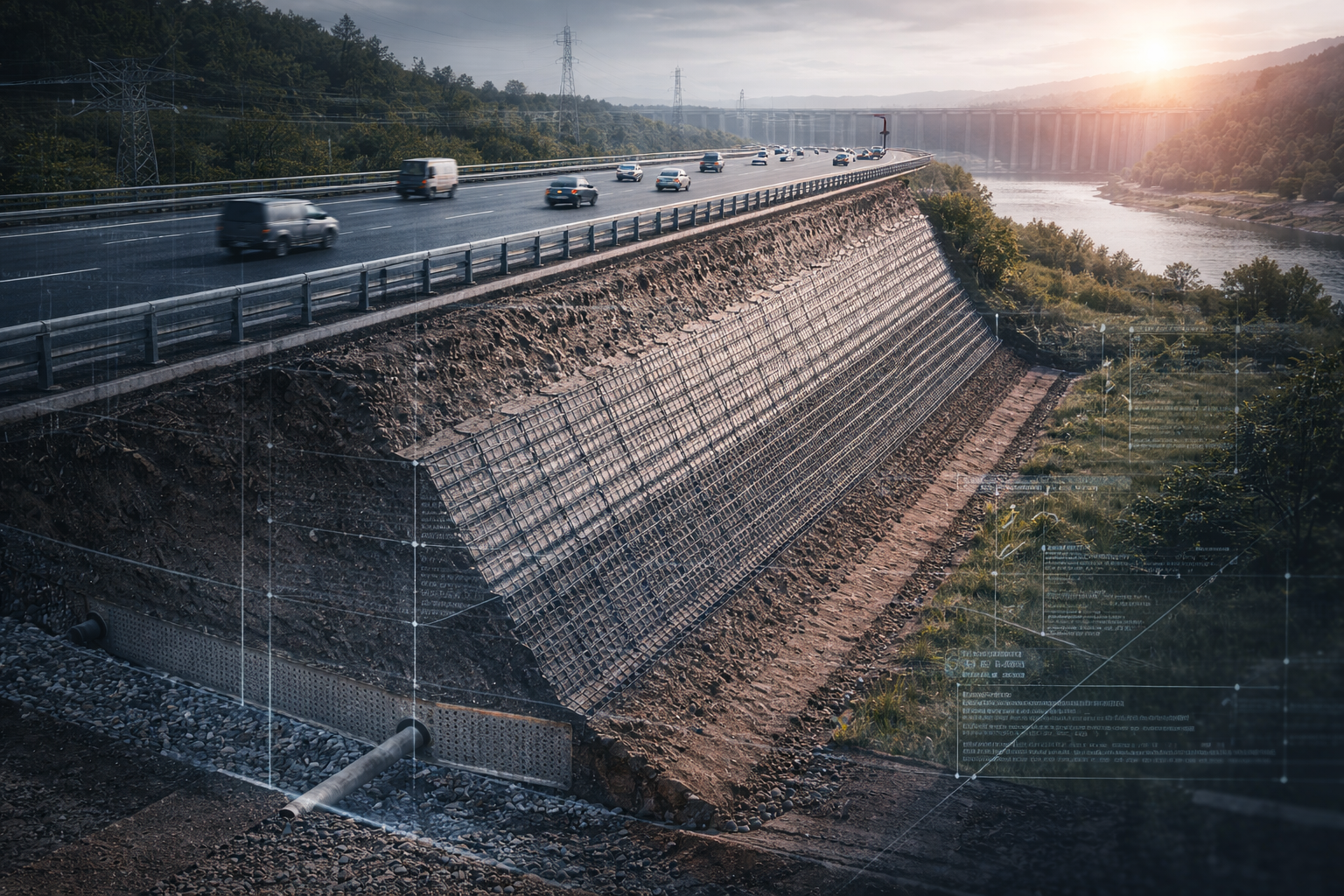
Institutional technical interpretations of soil mechanics, reinforcement interaction, hydraulic control systems, and lifecycle durability behavior across geosynthetic infrastructure applications.
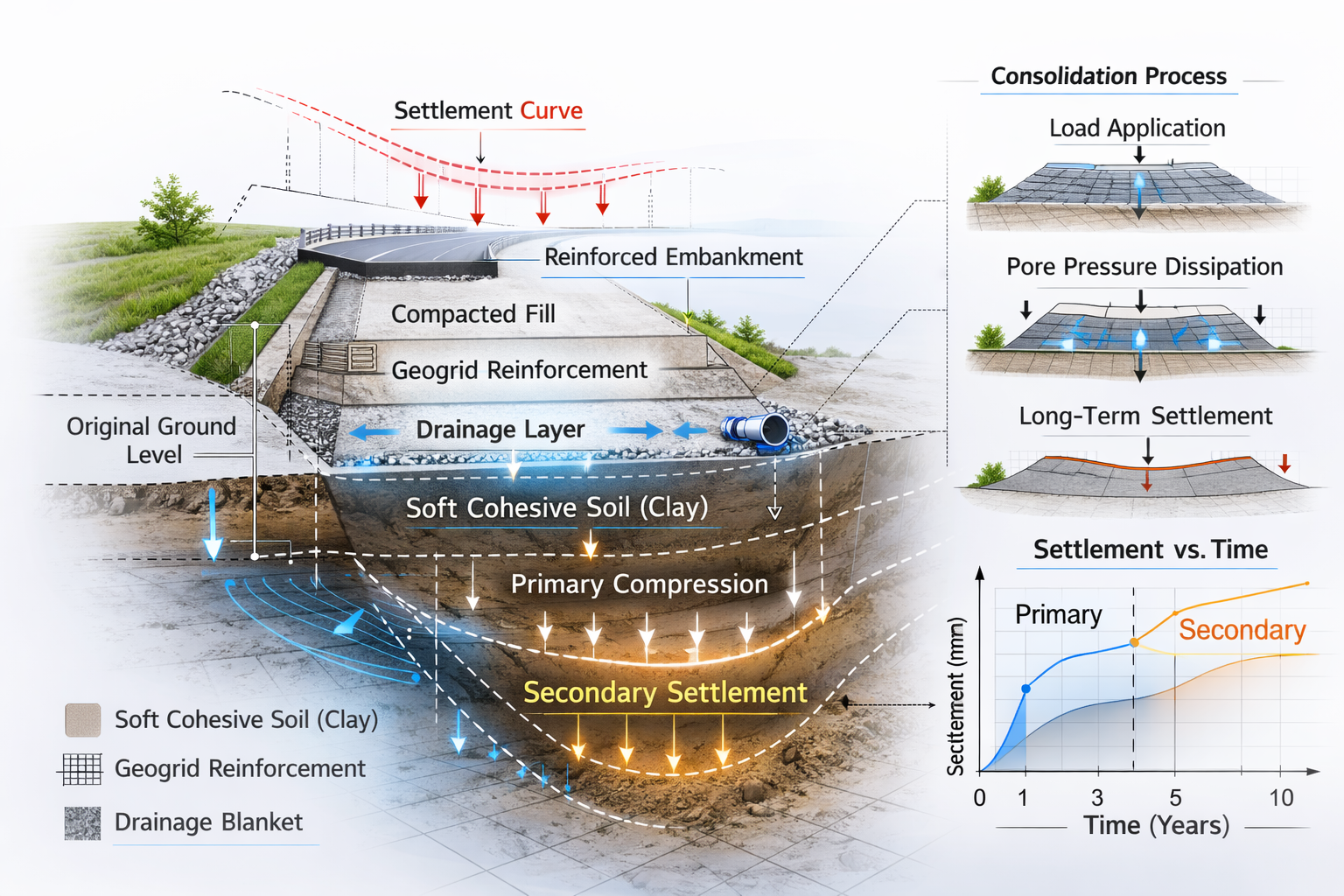
Post-construction embankment distress frequently arises from underestimated consolidation behavior in soft cohesive soils. Secondary compression and excess pore pressure dissipation continue well beyond initial compaction phases.
Inadequate reinforcement integration, drainage layer misalignment, and improper staged loading progressively reduce long-term structural stability.
Consolidation rate miscalculation
Insufficient basal reinforcement stiffness
Drainage path obstruction
Differential settlement amplification
Technical field evaluations across roadways, retaining systems, containment structures, and hydraulic channels reveal repeated patterns of soil-structure interaction misalignment.
Escalating lateral earth pressure due to inadequate drainage media and absence of internal reinforcement layering.
Subgrade shear deformation amplified by repeated traffic loading without sufficient tensile load distribution mechanisms.
Hydraulic conductivity imbalance caused by liner discontinuity and absence of barrier membrane integration.
Factor of safety misjudgment and improper reinforcement spacing leading to progressive shear plane mobilization.
Differential compression across weak strata without basal reinforcement or load transfer optimization.
Stress concentration and puncture vulnerability due to inadequate subgrade preparation and cushioning layers.
Sustainable infrastructure performance is not achieved through material selection alone. It is achieved through system interpretation, soil-behavior forecasting, hydraulic interaction modeling, and reinforcement integration discipline.
The TechnoBris™ Insights Division documents recurring field observations, technical misalignments, and validated system corrections to support measurable infrastructure accountability across India.
Structured engineering clarity reduces lifecycle risk, improves capital efficiency, and strengthens regulatory compliance alignment for long-term infrastructure durability.

Explore how geosynthetic systems, reinforcement logic, and hydraulic control frameworks integrate into structured infrastructure delivery models.